Leadership case 03
USS Hawaii (SSN-776) · U.S. Navy · 2005—2010
Building readiness around nuclear reactor controls.
Reactor controls, shipyard discipline, and a watch team ready for sea.
As an original crew member and Nuclear Electronics Technician aboard USS Hawaii (SSN-776), I worked in reactor controls, electronics troubleshooting, calibration, and commissioning readiness. Most of my tour was spent in shipyards. The S9G provided a foundation in modern instrumentation, operating-log analysis, and integrated control systems. The lasting discipline was broader: understand the expected response, isolate faults, control repairs, and verify the system.
This is a public, non-sensitive leadership summary. Technical and operational details are intentionally omitted.
The operating challenge
Commissioning required coordinating construction, repair, calibration, configuration control, and controlled testing while the watch team became operational. Readiness depended on documented equipment condition, authorized work, and clear ownership across trades.
What I built and changed
From complexity to repeatable execution.
Understand why the plant responds
Nuclear Field A School, Nuclear Power School, and prototype training built the base in electronics, instrumentation and control, mathematics, reactor theory, thermodynamics, electrical and mechanical systems, and hands-on plant operation.
Instrument, log, and compare
Operating-log analysis and trend interpretation connected individual indications to plant response: know the expected condition, recognize a departure, and understand its effect on connected systems.
Troubleshoot with evidence
ETMS and advanced coursework deepened the six-step Navy foundation—recognize and elaborate the symptom, list and localize probable functions, trace to the circuit or component, analyze the failure, then verify the correction.
Isolate before replacing
In one repair program, component-level troubleshooting supported a roughly $3,000 part solution instead of treating an approximately $50,000 system as the replacement unit. The larger lesson was to prove the failed boundary before spending at the system level.
Control shipyard execution
Managed a roughly $1 million repair budget and held calibration-control responsibility. The work connected scope, authorization, documentation, configuration, cost, calibration status, and independent verification to daily execution.
Test, verify, and transfer readiness
Supported controlled test and evaluation. Procedures, qualifications, precise communication, and independent verification connected technical work to watch-team readiness.
The result
Our team helped bring USS Hawaii from shipyard construction into commissioned service. I carried forward practical experience in work control, calibration, repair economics, cross-trade coordination, and watch-team readiness—the foundation for my later equipment and operations leadership.
“Readiness is a system, not a checklist.”
Technical background: public nuclear systems principles
These public principles illustrate how I study connected systems. They do not describe a proprietary process, a specific plant layout, or a claim of process-design ownership.
Technical lens · Public PWR principles
Read the plant as connected loops.
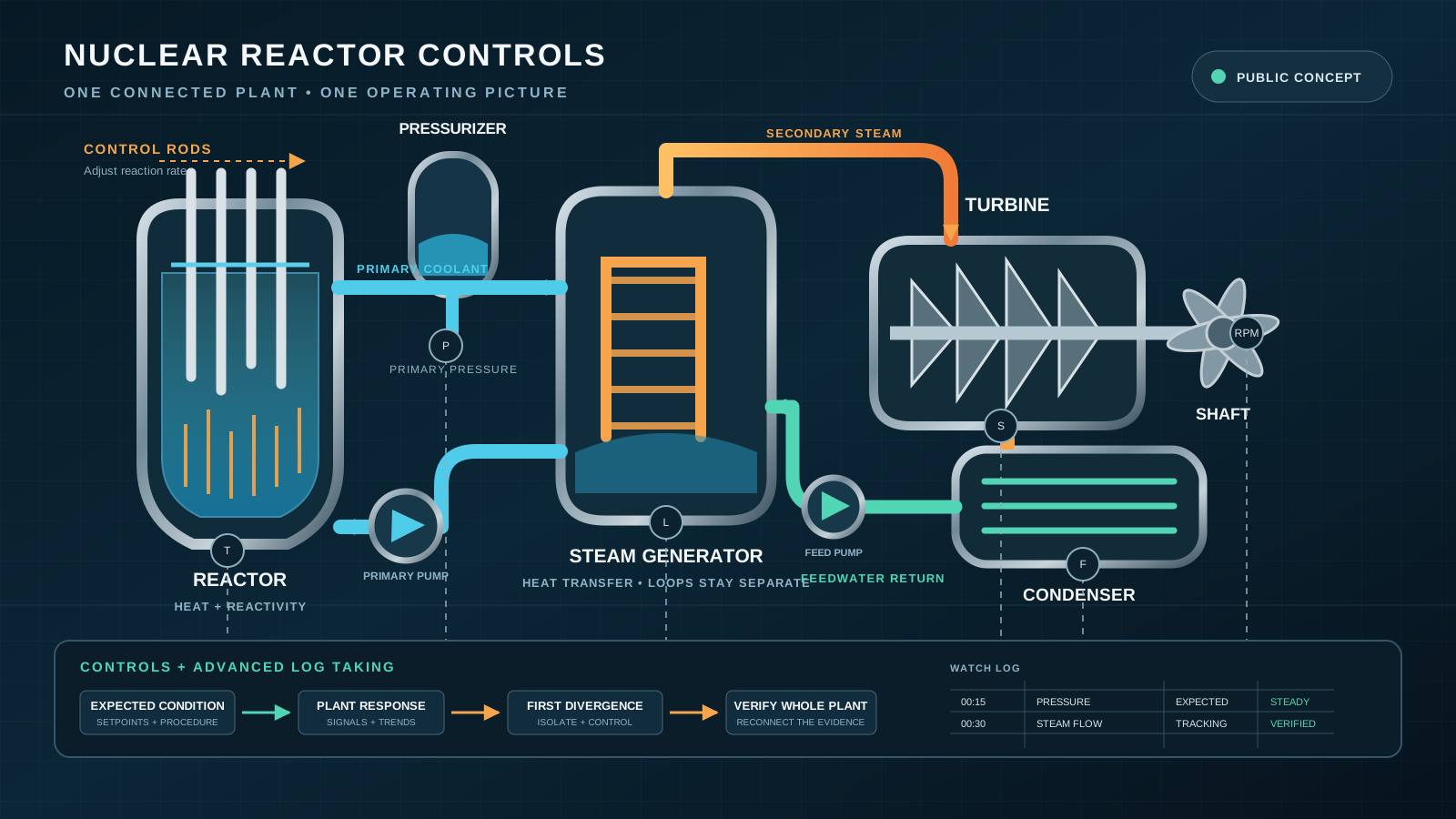
A public pressurized-water-reactor model makes the systems discipline visible without representing an S9G layout. Control rods shape reactor response. A pressurized primary loop carries heat to a steam generator. A separate steam-and-feedwater loop drives the turbine and shaft, condenses, and returns. Instrumentation ties every condition back to the watch team.
Control heat generation
Control-rod position and instrumentation connect commanded action to reactor response.
Carry and transfer heat
The primary loop maintains coolant pressure and transfers heat across the steam generator without mixing the two loops.
Turn steam into propulsion
The secondary loop converts transferred heat into steam, turbine work, and shaft output.
Condense, return, and verify
The condenser and feedwater path close the cycle while logs, indications, and trends verify the whole plant response.
Looking for an operations leader?
Start a conversation